Showing posts with label de Rennes. Show all posts

Saturday, June 23, 2012

King Raymond I "the Great" (1323-1354)

Gilla-Ruad II's son, Raymond, was much like his father. He was a devout Christian, friend to Popes, and a fierce warrior. But he was more. Everything good about his father was magnified in the young man who followed him. His faith was not expressed through the act of crusading (there was no Crusade during his reign) but through writing; he wrote several biographies of local saints, most of which reside in the University of St. Brieuc's special collections to this day. He was brave but not rash, friendly to all he met, whether friend or enemy, and one of the hardest working rulers in Brittany's history. It was not unusual to find him going through the censuses and tax records well into early morning, waking on only four hours sleep for personally led military drills.


He was tested early on by a Cornish rebellion, with yet another attempt by Scotland to sneak the duchy away from the Bretons, but this was, remarkably, the only rebellion he would deal with in his entire reign. He was wildly popular, both due to his personal qualities, his obvious capability for rule, and the first stirrings of a modern sense of national identity amongst the people of the Triple Kingdom.

The Cornish rebels didn't hold out long. They rebelled shortly after the 17 year old Raymond's coronation, taking up arms in early 1324, but were put down by late 1327. The Scottish weren't even a real problem; despite eclipsing England as the dominant power on the Isle of Britain, their troops were largely uninterested in marching south for another stab at Cornwall.

On May 1, 1239, King Raymond I married his betrothed, Queen Eleanor I of England. The young queen's situation was entirely precarious, with several rival claimants prepared to do battle over the throne. England, by the time of the marriage, was essentially a battleground for France, Wales, and Scotland, with the English throne entirely at the mercy of largely autonomous vassals. With Raymond's marriage, the crown was set to pass to Brittany's ruling dynasty. This situation was not one which France was willing to tolerate.

As Eleanor set off for her nuptials, she faced two serious wars. The first, a rebellion by the Duke of Oxford. The second, and more serious, was against France. King Renaud II of France had brought the entire southern coast of Britain into his borders through the inheritance of Bedford by the Duke of Champagne. He had a vested interest in seeing Eleanor deposed in favor of the only person in his court with a viable claim: her aunt Catherine.

The familial relationship is worth mentioning. Catherine's daughter was Catherine of Kent, Gilla-Ruad II's second wife and Raymond's stepmother. The Countess of Kent also happened to be the mother of Osmond de Rennes, Raymond's half-brother and, if the elder Catherine's claim was successful, the potential future King of England.

With the confusing, incestuous backdrop of dynastic politics set, Raymond went to war before a formal request of aid was sent. He demanded the County of Eu from Renaud II in his capacity of Duke of Normandy, launching a devastating invasion of the French heartland as soon as it was sent.

The war with the French was a tale of two conflicts. In Britain, France had amassed a truly stunning display of military might, besieging the English population centers with sheer numbers which could not be matched by the combined English and Breton forces. To boot, he had called on his ally, the King of Denmark, to supply reinforcements. Time and again, the Irish troops which were raised in the Isles were cast back. England was lost.

All of this activity in Britain left the French countryside largely defenseless. The Bretons experienced little resistance, even taking Paris, itself, after a year long siege. The names of Maine and Anjou, taken by Renaud II from Raymond's father so many years ago, were on the lips of every stout-hearted Breton as he stormed the Paris gates.

The war lasted six years, until 1335, and was a bit of a split decision for the Bretons. Eleanor was deposed in July of 1334 and her aunt Catherine named Queen Catherine I of England. The former queen was allowed to keep her baronial holdings in the countryside of Kent, though she spent most of her time in Rennes Castle with her husband.

The prize of Eu was gained by the Bretons in May of 1335. Renaud II had died of old age during the conflict and his son, Guy II, was a weak ruler and eager to end his father's war. Eu was ceded to Raymond as a part of his personal demesne.

Two years of peace ensued for Brittany, though not for France. Rebellions popped up here and there after Guy's war against Brittany and England, culminating in a full-fledged disintegration of France in 1337. The revitalization of French culture and arms which Renaud II had presided over seemed to have died with him. Guy II was presiding over an increasingly desperate situation, as Champagne, Burgundy, and Valois all revolted.

Raymond sensed a chance to expand the Breton borders once more, this time by coming to France's aid. The southern provinces of France were once part of the Kingdom of Aquitaine. Raymond sought to bring them back into the renewed kingdom of that name. He swiftly claimed Armagnac, Marsan, and Dax, all provinces of the divided Duchy of Gascony. All three capitulated quickly, with Armagnac and Marsan won in 1339 and Dax won the following year.

During the years of war, another, smaller succession crisis threatened the cohesiveness of the Irish third of Raymond's kingdom. His cousin, the King of Wales, had inherited Connacht in 1337. Raymond let this alone for three years, until his campaign in southern France was concluded successfully. Once he had gained his Gascogne provinces, Raymond reclaimed Connacht and marched into Wales; it took less than a year for the well past its prime Welsh kingdom to relinquish Connacht back to the Breton crown.

Brittany's entanglements in France did not end with the capture of most of Gascony. Increasingly, Raymond began to see France, rather than Scotland or England, as his main rival. He married off his daughters to French dukes, enmeshing him ever further into the turbulent French dynastic politics of the mid-14th century. This reached a head in 1343.

The Duke of Galicia, a vassal of France, had claimed the throne from Renaud III, Guy's nephew, after the successful war to depose King Guy II. Raymond's sister had been pledged in marriage to Duke Jaufre of Galicia. With the conclusion of the marriage ceremony, Raymond and Jaufre were allies in the effort to see the Duke of Galicia ascend to the throne of France.

Raymond was only too pleased to help his new brother-in-law. He had a great distaste for the Valois family who had taken it from the much more estimable Karlings (Jaufre was a Karling, descended from Charlemagne). Breton forces invaded a terribly divided France in aid of a hard-pressed Jaufre.

With the aid of Brittany's armies, Jaufre was crowned King Jaufre IV of France in December of 1345. While not great friends, Jaufre and Raymond carried on a decent relationship in letters and pledged to visit one another, either in Rennes or in Paris, each summer; they carried on this tradition until Raymond's death.

Jaufre would have need of the relationship with Raymond once again. In early 1348, Jaufre was in serious danger of being deposed, himself. The Flemish Duke sought to place his own candidate on the throne and, aided by the Duke of Champagne, largely had Jaufre on the ropes. Raymond offered his support unbidden; Jaufre accepted.

Again, it was Brittany saving France, a prospect unthinkable just 15 years earlier. The effort to save Jaufre's throne was successful, ending in October of 1349.


Brittany settled into peace for many years. Raymond's people and vassals loved him (out of character note: about 2/3 of his vassals had a relationship of 100, an astonishing clip I've never seen before) and he used his popularity to embark on another of his family's traditional building programs. Prosperity settled in and Brittany once again looked like an ascendant power.

Duke Torf of Aquitaine, the premier military strategist of the century, died in 1352 at age 69. He had served as Marshal for three Breton kings and had orchestrated the recent wars with France alongside King Raymond. He was buried in a ceremony fit for a member of the royal family. Emissaries from Byzantium and even the Shia Caliphate were present to pay respects to the old warrior. He was interred in the de Rennes family crypt, the only non-family member to ever be so honored.

Raymond would die in December of 1354. His last years had seen him become more and more stressed, sometimes spilling out into loud outbursts. He had seemingly felt the strains of his office more than he let on and had internalized these stresses to an alarming degree. Witnesses to his death, including Eleanor, describe what was probably a heart attack brought on by high blood pressure. He was 48.


There were some fears at the time that Brittany, after so many years of consolidation and power, was a kingdom on the decline after Gilla-Ruad II's sometimes loose reins with his dukes and his repeated defeats at the hands of the French. Raymond put these fears to rest. He was the first ruler to be at all considered an equal of Marguerite the Great, a man whose personal qualities were matched, finally, by his political capability. He both saw France to a stable outcome in its wars while also ensuring that it was a smaller, more pliable power after getting out of the kingdom's wars just in time to keep the Duchy of Champagne a powerful independent entity. To top it all off, he died knowing that his son might still inherit the throne of England from his brother, King Osmond I, since he had no heirs. He was a warrior and a scholar, one of the greatest, if not the greatest, kings in Brittany's history.


Wednesday, June 20, 2012

King Gilla-Ruad II

Gilla-Ruad II, the grandson of the first Gilla-Ruad, was a man of war. He did not, it should be noted, start out this way. He was personally cowardly at the beginning of his career, though this was mostly offset by his many other good features, including a highly deft political hand and friendly honesty of the best sort.


He was thrust into the wars over his career first by the remaining resentment against his grandfather's rule, then by his crusading impulse, and finally by a greedy France. Over the years of war, nearly without pause over his 15 year reign, he grew into a capable battle leader, aided by one of the greatest soldiers of the century in Duke Torald of Aquitaine.

Yet he was not by any means universally successful. Particularly when conflict with France arose, Brittany was forced to cede land in losing wars for the first time in the kingdom's history. This taints what would otherwise be a reign of extreme success.

When Gilla-Ruad came to power, it was as if the entire kingdom convulsed with the removal of his predecessor's boot heel from its neck. A few of the new king's vassals were relieved, attracted to the gregarious new ruler. Most, however, sensed an opportunity to settle old scores and flex their own political muscle.

Two weeks after his coronation, Aquitaine revolted. This was while the Cornish rebellion, and related conflict with Scotland, still burned. Notably, Aquitaine was ruled by Duke Torald I, Marshal of Brittany and true giant of 14th century military strategy.

Europe at the time. Note the HRE in Iberia and that Denmark inherited
Sweden and Poland
This was followed three months later by a rebellion in Munster. Gilla-Ruad was forced to quickly promote a new Marshal and split his forces three ways. Strategy held over from his grandfather's efforts to head off Scottish troops in Scotland proper were maintained, as well, meaning that there was a fourth siphon on Breton military power.

The already wobbly Cornwall was made the primary focus. They surrendered in April of 1309, freeing up several thousand troops for a march into Aquitaine. This they did, with a flanking force loaded up into ships for a landing on the French Riviera.

It was a good plan but France would spoil the good spirits of the Bretons. The French king, Renaud II, had designs on reclaiming Anjou. Informed of the outbreak of serious civil war in Brittany, he invaded Anjou. Gilla-Ruad was forced to immediately cede the province if he wished to hold his kingdom together; the French forces were too numerous for his depleted armies to hold off. Anjou was lost without a casualty on either side, marking the first time that Brittany had ceded land as part of a truce with another kingdom.

The rebellions were gradually put down. Munster capitulated in 1310, while Aquitaine lingered until June of 1312. After Torald surrendered, Gilla-Ruad accompanied him to Rennes Castle personally. There, in the dungeons, the two men had a long talk. The specifics weren't recorded, but Torald was released, his titles intact, after attending a feast in his honor. The Duke of Aquitaine was a loyal vassal and friend to the king from then on.

This friendship would be strengthened by the Sixth Crusade. Declared in January of 1312, while the battle between Gilla-Ruad and Torald still raged, the emphasis was once again on capturing Jerusalem. Shortly after Torald was released, Gilla-Ruad set off on crusade.


The King of Brittany led the effort against the Shia Caliphate. Bolstered by interest from Norway and Scotland, the Sixth Crusade met with some actual success, though none of it was lasting. Gilla-Ruad famously shed his reputation for cowardice in a huge pitched battle on the banks of the Dead Sea, leading charge after charge against the forces of the Emir of Petra.

Gilla-Ruad would stay in the Holy Land for seven years, until May of 1319. By that year, the situation had stalemated. With long supply lines, the crusaders couldn't keep up the effort, even though they established solid temporary holdings in Cyrenaica and Tyre. Slowly, they were pushed back. With the unsuccessful outcome obvious, Gilla-Ruad packed up his forces and returned home, letting the Sixth Crusade peter out without more Breton and Irish death. This it would do in 1322.

His years away had cost him his wife. In March of 1318, Queen-Consort Romilda died of an unexpected illness at only 30 years of age. Their son, Raymond, had been recently betrothed to the young Queen of England and suddenly found himself Duke of Swabia, swept away at the age of 12 to a strange court in a strange land.

Gilla-Ruad remarried, to Countess Catherine of Kent, but the double blow of his wife's death and his return from war left him largely despondent. He entered a deep depression which he never fully came out of for the rest of his life. He put on a good show for his subjects, but letters written to his dear friend Torald of Aquitaine reveal a man unsure of his place in the world.


France, in 1321, bore little resemblance to the barely constrained anarchic mess which it was barely 25 years prior. Having inherited the Duchy of Bedford away from England's borders, the French king found himself with enough raw muscle to put down many of the rebellions which had plagued the kingdom for more than a century and a half.

In April of that year, France decided to bring that muscle to bear on Brittany once more, this time over Maine. Gilla-Ruad had cultivated a good relationship with Pope Severinus II over the course of the Sixth Crusade, and he quickly urged the Pope to consider excommunicating the French king. The Pope was only too happy to oblige after Brittany's heavy lifting in the Holy Land; Renaud II was excommunicated by May.

Even with Renaud II's predicament, the French were simply too much for Brittany, who had not had time to fully recover from the all-out effort during the Crusade. The Bretons fought bravely, led largely by Turold, but even his genius couldn't match France's overwhelming numerical superiority. Brittany surrendered Maine to the French in late 1322.

Gilla-Ruad withdrew further into his depression. His brothers-in-arms from the Sixth Crusade tried to steer him back to a productive course, to no avail. He largely shut himself off from human contact, the weight of losing the Duchy of Anjou weighing heavily upon him. On July 8, 1323, the Crusader King died after a short illness. He was only 37.


Monday, June 18, 2012

King Gilla-Ruad I "the Cruel" (1280-1308)


The career of King Gilla-Ruad I, known as The Cruel, is a source of controversy for the people of Brittany. He rivaled his grandmother, Marguerite the Great, in terms of centralization and effectiveness of his rule. But that effectiveness was in the eye of the beholder, for he was needlessly cruel, ruthlessly crushing opposition in the crudest possible ways. He assassinated rivals and wives with no hesitation and executed scores of those who underestimated him. Where Marguerite was a scalpel, Gilla-Ruad was a hammer. His father, Payen I, doesn't even enter consideration when Gilla-Ruad is discussed; he despised his father for marrying him off to a woman he intensely disliked for political considerations. He also thought Payen was incredibly weak for what he viewed as yielding to the Irish. This was not motivated by cultural animosity, as it was in years past; Gilla-Ruad hated his Breton subjects (he identified as Norman, raised as he was in neighboring Mortain) as much as he did anyone in Ireland. He simply thought that killing Irishmen by the score and setting up their heads on pikes as mile markers was more effective.

He was a remarkably venal, petty, and unpleasant man. Despite his paranoia, he hated to be alone, keeping people talking well past the point of exhaustion into the night. He was also nightmarishly bad with money, breaking the long line of de Rennes masters of money. He was so bad, in fact, that he had to yield the newly gotten Duchy of Toulouse as an early act of governance, simply because he couldn't juggle the added territory in his demesne. He made his (and his father's) Marshal, Prince Turold, the Duke of Toulouse.

Since he was crowned at the age of 50, nobody, even Gilla-Ruad, was expecting a long reign. His son, Gaufrid, was married off to the Duchess of Holland at the earliest possible opportunity in an effort to snatch Holland from the periphery of the Holy Roman Empire. With Mortain brought under Breton rule with Gilla-Ruad's ascension, Brittany was looking at a situation where the entire northern coast of France was no longer under French rule. Gaufrid was primed to come back to Brittany as king within five or ten years.

Instead, Gilla-Ruad would rule for 28 years and Gaufrid would die before ever sniffing the throne of Brittany.

His first act as king was to order the murder of his wife. With the sudden influx of resources available to him as king, it was simple. She didn't even make it out of Mortain; the king had left to be crowned at Rennes a week prior to her departure and she was murdered on the road by hired assassins posing as bandits. That Gilla-Ruad used this as an excuse to crack down on the people of Mortain in the interest of keeping order, leading to the hangings of around a hundred innocent men, reveals much of his character.

Gilla-Ruad would reveal an uncanny knack for sticking the knife into his neighbors' backs early on. In April of 1281, he used a fresh dynastic crisis in England to war with the island kingdom over Maine. With the English king in bad straits in his home territories, the ordinarily overwhelming force of the English couldn't make it over the channel. Maine was ceded and given to the Breton Prince-Archbishop of Anjou to rule in 1283.

The intervening year of 1282 saw the Fifth Crusade called off. As bad as the Fourth Crusade was for Christendom, the Fifth was even worse. Not a single shred of land was gained. The crusaders could barely land in Egypt before the Shia Caliphate's massive armies threw them back. The Fifth Crusade marked a low ebb in the Pope's authority in Europe.

That same year, Gilla-Ruad ordered his second murder. The young Duke of Leinster, Conchobar II, was due to marry Gilla-Ruad's eldest daughter, Margrite. When his younger brother died, leaving Leinster to revert back to the crown should Conochobar die, as well, Gilla-Ruad ordered a team of thugs to beat the 11 year old to death in his room one evening. They succeeded, though one of the assassins was caught and let slip the name of the king. Gilla-Ruad's vassals were appalled and restless; the king didn't care. Leinster was given to one of Gilla-Ruad's chosen courtiers.

Gilla-Ruad's ascension to the kingship brought with it the Norman province of Mortain. With both Mortain and Evreux under Breton control, the time was right to make a move for Normandy. In 1284, Gilla-Ruad declared war on his nephew, the Duke of Normandy. Doubling as the husband of the Queen of Wales, he proved to be needlessly reckless on the field of battle; he wandered too far into the Breton lines and was captured in the first engagement. Brittany found itself in possession of Rouen three days into its war with Normandy and the Duke lived out the rest of his days in shame at the Welsh court.

Brittany found itself eclipsing France and England as the dominant power in Western Europe. Both of those kingdoms experienced terrible internal strife from 1200 on, while Brittany was largely cohesive, periodic Irish revolts excepted. Gilla-Ruad pressed the advantage on the French territories in 1289, just as he had with the English and Maine in 1281. With all of France rising up against King Gauthier I, Brittany swooped in to claim the remainder of Aquitaine. France barely minded since Aquitaine was helping the rebellion.


With Aquitaine and Toulouse part of Brittany, the ancient, pre-Frankish Kingdom of Aquitaine was revived under Breton rule. The Dual Crown of Brittany and Ireland became the Triple Crown of Brittany, Ireland, and Aquitaine. He proclaimed the new kingdom in Bordeaux and followed the coronation with a slaughter of local heretics in public. Gilla-Ruad then returned to Rennes, turning over the newly won provinces to the Duke of Aquitaine.

By 1290, Ireland once again chafed under Breton rule. Gilla-Ruad, for all that he expanded the borders of his kingdom, was terribly unpopular. His 1283 attempt on the life of the Count of Zeeland because he stood to inherit the Duchy of Ulster, unsuccessful and sparking a foiled counter-attempt by the count on Gilla-Ruad's life, began the slow burn toward Irish rebellion. As always, the sea made the distance between Brittany and the island longer than it seemed; what Gilla-Ruad could control directly on the continent was tough to equal in Ireland.

Ulster was the first to rebel, in April of 1290. Gilla-Ruad was infuriated and raised every troop the kingdom could muster. In correspondences with his council, a very dangerous course of action was set. Gilla-Ruad saw the rebellions as a byproduct of his family's historical leniency in dealing with insurrection. Invariably, the titles were stripped from the ringleader and given to another member of his family. Gilla-Ruad decided that it was time to reshuffle the deck; above his council's protests, he declared that any surrendering leader was to have all titles stripped and the offender banished. The theory was that he could dole out the titles to close allies, preventing the generational rot which he saw at the heart of Irish rebellion.

Gilla-Ruad's advisors were appalled. This was tyranny of the crudest sort, the type of thing that might exacerbate already raw feelings in other parts of the kingdom. Gilla-Ruad was unpersuaded. The might of Brittany was aimed squarely at the kingdom's own people. The Bretons boarded their ships and marched on Ulster.

1291 brought more rebellion. Duke Eon II of Cornwall rebelled, as well. As they had on two prior occasions, Scotland quickly took the opportunity to attempt a quick snatch of the Cornish titles. The Battle of Bodmin, in April of 1292, saw the invading Scots repulsed. Gilla-Ruad shrewdly ordered a force of 10000 men to the western coast of Scotland to intercept any attempts to conduct a second invasion of Cornwall. Some small forces snuck through, which, when combined with the further rebellions, extended what should have been a simple conquest terribly, but no serious threat was mounted to Breton command of the Cornish situation.


Ulster capitulated in 1294, with the ducal title given to the Count of Tyrconnell. Cornwall followed, in 1296. Duke Eon II of Cornwall would not fair well; he was executed, his body put on display on the walls of fabled Tintagel Castle, and his titles fell to his pliable daughter, Constance.

January of 1297 brought more death and rebellion. Abroad, Prince Gaufrid's wife, the Duchess of Holland, died unexpectedly from illness. Gilla-Ruad's grandson and second in line to the throne, also named Gilla-Ruad, was named Duke of Holland at the age of 8.

More alarmingly, the de Rennes' family's trusted friend, Duke Turold of Toulouse, was caught planning to take the crown of Aquitaine from Gilla-Ruad. Forces were dispatched to the south to capture him, but the legendary warrior and his guard defeated the would be captors handily. Turold rebelled.

This was followed two years later with the rebellion of Leinster, proving that Gilla-Ruad's strategy of placing as many titles as possible into the hands of already trusted allies was not foolproof. Toulouse was the primary objective, with Leinster left alone for the time being. Turold surrendered in 1300 and was locked away in the Rennes Castle dungeon for the rest of his life.

As a sideshow to the main de Rennes tale, Gilla-Ruad's daughter, Sibylla, was married matrilineally to the heir to the Welsh throne. While it certainly would not unite the kingdoms as the de Rennes family had historically wanted, it would bring a de Rennes heir to the Welsh throne.

The Duchy of Meath revolted in late 1300, giving no rest to the weary Breton troops. Leinster surrendered in 1302, only to have Connacht revolt the next year. Ulster rebelled again in April of 1304, meaning the entire island but Munster had bubbled up in open warfare against Brittany. Gilla-Ruad steeled himself, confident of victory.

When Meath surrendered in October, 1304, Duchess Eustaice was banished and her titles given to one of Gilla-Ruad's grandsons. August of 1305 brought victory in Connacht, followed by another banishment; this time the titles were given to a favorite nephew.

January of 1306 and another rebellion, again in Cornwall and, again, followed by Scottish meddling. Ireland was slowly being reigned in but the prospect of more warfare against the increasingly powerful Scottish was demoralizing to many in Gilla-Ruad's inner circle. Louder grumbling about the old man's rule was heard more frequently.

In July, 1306, the king's heir, Prince Gaufrid, died at the age of 45. The new heir was Gilla-Ruad's grandson, the Duke of Holland. If the old king felt any sadness about his eldest son's death, no record was made of it. The minutes record only that, on the day the news was received, Gilla-Ruad sent off an official letter to the Scottish king condemning their behavior in Cornwall before eating a meal of mutton and blackbird pie, chased down with wine from his cherished Bordeaux.

In January of 1208, shortly after Ulster's surrender, Gilla-Ruad died of old age at the age of 77. His rule was largely spent putting down rebellions of his own making and his people largely hated him while he was alive. Yet his successful campaign for both Normandy and Aquitaine, the latter marking the reformation of the kingdom once home to Lancelot, mark him as an effective military leader. As well, his efforts to replace the dukes of Ireland with new families less prone to rebel against Breton rule, regardless of the diminishing of his personal reputation, have to be viewed with a certain amount of awe, even though the tactics used to achieve this were repulsive.


No coins are adorned with Gilla-Ruad I's face, no songs sung about him, no folk tales about him told lovingly around the campfire. There's a certain twinge of embarrassment in the face of a Breton when his name is mentioned. His reign was a mixed bag which saw highs and lows of Breton culture.

Sunday, June 17, 2012

King Payen I (1251-1280)

Marguerite's heir occupies a peculiar place in Breton history. He was an unassuming man, friendly and diligent, enjoying taking a hands on approach to rulership which sometimes gave his council fits. He was personally content, lacking the burning ambition which had been on display in recent generations of the de Rennes dynasty; in this way he was like his forebear, King Conan I. He would have made a marvelous alderman or guild leader in a quite, medium sized city somewhere, a place like Narbonne or Swansea.


But he was a king and he ended up being quite competent, even firey and passionate in certain narrow situations, such as when war against Islam was concerned. Most importantly, he was the first Breton ruler to attempt to bridge that always touchy divide between the Breton and Irish halves of the kingdom. Apprenticed to the Duke of Leinster, he cultivated a love for all things Irish from an early age. His name was chosen by his mother as a sop to the Irish by his larger than life mother; Payen would make certain that his attempted equal treatment of the Irish went much further than symbolism.

The death of his mother revealed long simmering tensions within the kingdom. The force of her personality and her unparalleled achievements meant that her authority was more or less unquestioned. Not so with Payen. The newly crowned king found himself facing a situation eerily similar to that early in Marguerite's reign. The Duke of Cornwall was in possession of the Duchy of Munster. This gave him an extremely advantageous position within the politics of the realm. Payen began maneuvers to change that.

The king had a claim on Munster, which he had no desire to actually take into his demesne, but he pressed it anyway, knowing it would put the Duke of Cornwall and Munster, Drogon II, in a bad situation. Drogon II refused, and reluctantly rebelled.

Payen's plan was simply to end the rebellion quickly, take Drogon down a notch, and dole the titles out to his own people. There was one flaw: the French political situation, always volatile, erupted into open civil war once more. This time, it centered on plans to lower the French king's authority. Payen had instructed his spy master to lend help to this effort, in the hopes of keeping French interest away from Normandy, which he hoped to incorporate into Brittany. Things happened too quickly, however, and Brittany was dragged into the French civil war on the side of the rebellious French counts at nearly the same time that the war against Drogon began.

To make matters worse, Scotland declared war on Cornwall in the hopes of installing Payen's sister, Duchess Adelaide of Lothian, on the ducal throne. Since Adelaide was married to a Scottish prince, the hope was that it would eventually work its way to the Scottish realm.

The complicated war persisted from early in Payen's reign in 1251 until 1260. It was a fairly low intensity conflict, with most of the major players involved in multiple conflicts at once. Adelaide was actually briefly installed as Duchess of Cornwall in 1257. This proved to be disastrous for her; Scotland had discharged its promised aid to her and withdrew to the north immediately. Payen declared a second war against her and only her the second the Scottish left; she surrendered quickly and was allowed to stay on as Countess of Devon within the Duchy of Cornwall.

Drogon surrendered shortly thereafter. He was spent, with his Cornish forces routed by Scotland while the Bretons ran roughshod over southern Ireland. His titles were stripped. He died a broken man shortly thereafter, his son being made the new Duke of Cornwall but the family's hold on Munster forever broken.

1260 brought an end to the French civil strife, with King Gaucelin III of France still on the throne and his hold on his kingdom strengthened. Payen wisely instructed his forces to steer well clear of the French situation and Gaucelin was only too happy to enter a gentleman's agreement to stay clear of Brittany in exchange. The French nobles who had counted on Breton aid were enraged and demoralized.

The decade of the 1250s had seen a shift in thinking, largely spearheaded by Payen, when it came to Breton's interests. The Iberian Muslim states had slowly made their way past the Pyrenees. It became an intolerable situation for both Brittany and France. Payen and Gaucelin III made a joint decree shortly after the end of Breton involvement in the French civil war that reestablishing the Christian kingdoms of Iberia was the top priority for their two kingdoms. Known as the Affirmation of Chartres, the Holy Roman Emperor lent his weight to the spirit behind it.

In addition to setting French eyes south and marking a decided shift in Breton attitudes toward expansion; instead of looking to Scotland and Wales in order to achieve the long desired greater Celtic kingdom, Brittany would remain fixed on Iberia for decades to come.

The Affirmation of Chartres also marked a waning of influence of the Church. This was a crusade in all but name, albeit one which was deliberately open-ended. Crusades were the Church's domain and the new order of things in Western Europe obviously skirted what had traditionally been the Pope's domain. But after four crusades with nothing to show for it but the ignored Iberian Muslims creeping halfway into traditional French lands, the lands of Charlemagne's former empire had had enough.

In 1262, on Christmas Day, Payen announced that he was going to throw the Mauretanians out of Toulouse. He gave a rousing, out of character speech at the traditional Christmas feast at Rennes Castle; his vassals pledged to follow him to Hell and back if that's what it took.

The Breton armies made short work of the Mauretanians. The Muslims were far from home and still fairly new to their conquests, though they had done an amazingly thorough job of converting the Occitanian and Frankish population to Islam. The Iberian states were a fractious lot, as well, constantly warring and squabbling with one another, in direct contrast to the massive, frighteningly powerful Shia Caliphate which had ground the Mongols of the Ilkhanate to a standstill in Mesopotamia. Brittany claimed Toulouse from the Caliphate of Mauretania in July of 1264.


This marked a period when Payen became increasingly prideful. While still as personable as ever, he became less prone to allowing question of his methods and effectiveness. More damaging, he took up with Anastasia Taechaneiotes, the beautiful Greek wife of his nephew and Marshal of Brittany, Prince Turold of Sicily. Anastasia would bear Payen two daughters, Martha and Anthousa, the latter in 1277, when he was 65 years old. He would make both his legitimate daughters, embarrassing his nephew to no end.

His wife, Marie, would die in 1270, a year after his torrid affair with Anastasia became more or less common knowledge. She retreated to her chambers when she discovered the affair and disappeared from daily courtly life almost entirely. It was said that she died of embarrassment.

Shortly after her death, Payen married Klara, second daughter of the king of Denmark. He was still, in his pride, quite open about his preference for Anastasia. If the new queen minded, she never said; she bore him several children.

Most of Toulouse was slowly pacified, but two provinces remained outside Breton control. One of them, Melguiel, was under Genoese control, the great city-state having wrested control of the province from Muslim control long before the Affirmation was even a consideration. Payen, seeing the Genoese as soft, declared war in order to bring Melguiel under the control of Brittany.

Genoa would prove a tough nut to crack, much tougher than Payen and his council had anticipated. The war with Genoa coincided with terrible turmoil in the general area. England had declared war on France after Gaucelin III had been excommunicated. This stirred the usual resentments amongst the French nobility, who quickly split into numerous camps, each trying to overthrow Gaucelin in favor of its own candidate. Things would have played out in the normal fashion save for England succumbing to the same pressures. Both kingdoms dissolved into innumerable warring factions, warring along cultural as well as geographical lines. The wars would rage throughout the 1270s.

Pope Sabian II would try to redirect attention to his own targets in 1276, at the height of the Genoan war, by declaring the Fifth Crusade. This time the target was Alexandria, rather than Jerusalem. Response was muted, with only a handful of duchies committing, along with the now negligible Kingdom of Wales. It would continue smoldering throughout the decade and beyond, the Pope's terrible timing assuring that none of the large kingdoms could commit to seeing the Fifth Crusade to a proper conclusion.

In may of 1277, Genoa ceded Melguiel to Brittany. The merchant republic had stayed aloft by funding numerous Italian mercenary companies, which created a stalemate for a few years. In the end, the Breton and Irish forces were too many and too skilled for the Genoese to beat back.


Payen died in 1280 at the age of 67. His reign had been continued the general trend of Marguerite the Great's in terms of a careful balance of conquest and good domestic governance. He left behind a staggering eleven children, nine by his two wives, the latest born when Payen was 65 years old. His identification as at least as much Irish as Breton helped to keep the Irish people, who loved him right back, calm. The Irish were equals from that point forward.

Monday, June 11, 2012

King Ogier I (1196-1212)

Ogier was never more than a boy during his reign. He came to power at the age of five months, his great-grandmother, Judith, serving in his stead. He died at the age of 17, just barely over a year after reaching the age of majority.

The decade and a half of his reign was one of constant warfare, as Irish reactions to generations of Breton rule gave way to a series of crises on the island, pulling in England and Wales in full-fledged warfare. The teenaged king died having never known a moment of peace in his short life.

Judith, finding herself Regent of Brittany for an astonishing fourth time, saw to it that war with Ulster was a top priority scarcely after her grandson, Briant II's, body had cooled. It was, as she wrote at the time, a question of restoring the kingdom's priorities. The Duchy of Ulster, recall, had been let go of in the face of too much opposition from Wales and Munster. Judith aimed to rectify this mistake.


So it was that Breton troops found themselves embroiled in Irish warfare once again. In 1196, a large contingent of Breton troops, mainly footmen and archers, made the march from Leinster to Ulster, laying siege to Tyrone's cities as a top priority. The Ulster armies were outnumbered and outmatched.

Salvation for Ulster would come in the form of another rebellion by the restive Connacht. Duke Art I, the famed Imag's son and heir, died in May of 1196, shortly after the invasion of Ulster began. His son was an ambitious and tenacious man named Finnsnechtae. The day that Art was buried, his son declared a perpetual rebellion against Brittany in support of Ulster and all Irishmen everywhere.

So it was that the holder of the ducal seat of Connacht, for the third successive generation, rebelled against the crown of Brittany.

The three way war raged for two years before Wales, sensing another chance to sneak the county of Breifne away, invaded the Irish coast with a force matching the size of Brittany's initial invasion force. 1198 was a year of stalemate. The Ulster and Connacht forces had largely been crushed by Brittany, but neither Wales or Brittany could get the better of the other. It was a replay of the Irish wars of Briant II's reign, with Wales outmatched on a man per man basis but Brittany unable to bring the full might of her arms to bear due to distance.

In 1199, Queen Mother Judith, Regent of Brittany, great-grandmother to King Ogier, grandmother to Briant II, mother to Barthelemi I, wife to Briant I, died in her sleep of old age. She was 79 years old.


It is impossible to overstate the importance of Judith in the history of Brittany. Of the combined 41 years on the throne of her grandson and great-grandson, she was regent for 24 of them. She was spymaster for all of them, and her son's and husband's reigns, as well. She was a force of nature, energetic and vital to the last. She did terrible things, for certain, but given the short, periodically weak reigns of her descendants, such things were perhaps necessary to keep the kingdom together at all. As well, viewed in total, her crimes (excepting the murder of her first great-grandson in his crib, which is fairly singular in its monstrosity, at least in the region) are no worse than those of most contemporary male rulers.

With Judith's passing, Chancellor Odo de Rohan became Regent of Brittany. He was more personally diplomatic and outgoing than Judith, though without the knack for grand strategy. The prolonged stalemate in Ireland may be lain partially at his feet, as he dithered more than once when swift action was required.

The boy king suffered another personal blow when his mother, Queen-Mother Barbara, married the Holy Roman Emperor, Kaiser Berthold von Rheinfelden. This was to unite the houses of Salian and von Rheinfelden in marriage. Berthold was, at the time, rather insecure in his throne. Ogier, who was emotionally fragile and a bit slow, was left bereft of family besides Marguerite, his older sister.

The war raged on with no end in sight. Indeed, it actually broadened. Chancellor Odo made a terrible mistake in 1203, when Prince Idwal of Wales was captured during the Battle of Cavan. He was the youngest son of the Welsh king. Annoyed at Welsh intransigence, Odo ordered the 19 year old prince executed, rather than ransomed. His hope was that it would ruin Welsh morale; the opposite occurred. The Welsh doubled down and never forgot what they perceived as a terrible crime on the part of the Bretons.

1207 brought further expansion of the wars. On the home front, both distant Angouleme and Cornwall rebelled. In Ireland, the English laid claim to Ulster, bringing them into the abattoir. It was now a five way conflict on the Emerald Isle. Connacht was nearly spent, Wales on the ropes, Brittany close to declaring victory, but the arrival of the English changed the calculus entirely.

The next year, Aquitaine attempted to reclaim Angouleme whilst Breton attentions were turned northward. The historically French province was all but abandoned to the Aquitainians, as what few troops could be spared from the conflict on Ireland were sent to Cornwall.

Connacht finally, reluctantly, surrendered in 1208. Finnesnachtae was thrown in prison, his ducal title stripped in favor of his five year old son, a boy who, it was hoped, would prove pliable. The former duke was never released from captivity; he died three years later.

There was still no room to breathe. While the 12 year Connacht rebellion had finally been put down, fighting with Ulster wore on. The English were somewhat distracted by a conflict with France over the rule of Anjou, but it was temporary. In 1208, even Odo knew that fast action was needed to secure the Duchy of Ulster, before the superior English armies had time to turn their attentions back to Brittany.

Abroad, February of 1209 brought the unsuccessful conclusion of the Third Crusade. What had been promising in the years when Briant II had set off on crusade had turned to ashes for the crusaders, just as the prior two crusades had. The Islamic states of the Levant were simply more cohesive and stronger than anything Christendom could muster. Especially hard hit was Denmark, who had squandered enormous amounts of treasure and blood to prop up the crusade. After 21 years, the kingdoms of Europe had nothing to show for all their efforts but a generation of dead men.

Wales would, in 1210, prove meddlesome to Brittany's war efforts, this time in Cornwall. The Welsh invaded in the hopes of claiming the Cornish peninsula but were driven back handily, though the Bretons were forced to rely on mercenaries to bolster their forces. In April of 2011, Cornwall would surrender, the title being given to long dead Duke Eon's brother, Drogon.

Ogier took the throne in truth as well as name on July 24, 2011. He was, as a young adult, a kind, brave young man. He also kept up the de Rennes tradition of budgetary skill. Interestingly, accounts by his sister and friends described him as being quite a bit slow, though his knack for numbers (often done personally, in his own hand, over the objections of his steward) contradicts this. Some historians have theorized that he may have been autistic, with the attribution of dim-wittedness being a mistaken product of its time.

Two months after his coronation, Ulster finally rejoined Brittany. This did not, however, mean the end of the war. England still had her sights set on claiming the duchy and, with the loss of Anjou to the French in 1210, had no distractions. With Ulster pledging to Ogier, the English were driven back, though all in Brittany knew it was temporary.

Brittany had been at war dating back to the beginning of Judith's regency in 1196. 1212 saw the possibility of peace, with the number of enemies whittled down to one, though that one (England) was the stiffest of all foes. 16 years of war had taken their toll on the people of Brittany's morale, both noble and commoner alike. That slim possibility evaporated in June of 1212.

Inexplicably, Sultan Mundir the Fat of Muslim Andalusia declared a holy war for Brittany. It was unprecedented. The Muslim states were usually the defenders in conflicts of the time. For a sultan in faraway southern Iberia to strike at the heart of western Europe was so bold as to be rash.

France rushed to Brittany's aid, with King Gaucelin II pledging his personal support and to ride side by side with Ogier against the sultan's forces. Ogier was said to have been surprised by this gesture but pleased. Never before in Breton history had the prospect of contact with the French raised their morale.

Ogier would never see battle against the Iberian Muslims. He had been wounded in a hunting accident after his wedding party. It had festered and turned gangrenous. He died on July 27, 1212 at the age of 17. Marguerite, his older sister, took the throne facing the English and the Andalusians in open war.


Sunday, June 10, 2012

King Briant II (1184-1196)

Briant II served as a stark contrast to his cruel father. He was kind and charitable, abstaining from wine and women outside his marriage. He possessed the tradition de Rennes temper, though it was confined to those who had truly provided offense, rather than the erratic outbursts of his father. He took his faith seriously and renewed the de Rennes' personal correspondence with the Pope during his reign.

Being only 14 at the start of his reign, Queen Mother Judith, his grandmother, saw herself as regent for the third time. The Duchy of Munster was once more restless, this time under the rule of Art, Imag's young son. Art's rebellion was quite a bit more dangerous than Imag's, however, for he had inherited both Connacht and Munster. This put him in charge of more Irish land than the royal crown and, subsequently, quite a bit more manpower than his mother ever had at her disposal.

Seeing another young king on the Breton throne, the duke rebelled two weeks after Briant's coronation. The Duke of Ulster declared independence the next week, sparking a full Irish rebellion against Briant's rule.


Judith resolved to crush the rebellion with as much force as possible, ordering the full might of Breton arms into the fray. Over 10000 troops were raised on the mainland and sent to reinforce the small but loyal Duke of Leinster's army. 8000 troops under Briant's banner, led by the Duke of Leinster, met Duke Art's forces on the plains outside Wexford on January 30th, 1185. The battle raged all day and into the next, ending the the Munster forces in full retreat. Loyalist forces harassed Art for a week, picking at his forces until he had practically no armies in the field.


Still, the war dragged on. The rebel garrisons were stout-hearted and well stocked with provisions to hold out for years. Worse, the situation forced the Breton war council to choose between Munster and Ulster; there simply weren't enough soldiers or supplies to handle both. It was decided to let Ulster take a back seat for as long as was needed to pacify the south of Ireland, even if that meant letting Ulster break free. Brittany settled in for a long war.

Briant reached the age of majority in 1186. He proved to be amazingly deft with money, able to wring every penny out of the books without raising taxes. Over the years, this seemingly preternatural talent with the kingdom's finances helped to offset the costs of the nearly constant warfare of his reign.

The same year, Briant married Barbara Salian, younger sister of the Holy Roman Emperor, Ernelrich I. She was a Lollard but converted during her wedding ceremony as a condition of the marriage. She was a good match for Briant, studious and kind. She was quite beloved by her subjects, referred to as Barbara Le Bon.


In 1188, the Wales and her ally, Normandy, joined in the Irish war. The kingdom laid claim to the central county of Breifne, held by Munster. The Welsh forces invaded with a massive force, scuttling any plans for a quick, simple dismantling of the Munster garrisons. A vicious three way conflict settled over the island, with no end in sight.

The following year, Briant and Barbara's first child, a girl named Marguerite, was born. She was healthy and fair, proving quite popular at court as she grew up.

In early 1191, the first step in the cessation of the interminable seven year long Irish rebellions occurred with the granted independence of the Duchy of Ulster. Briant, in his letters, resolves to his council that he will retake the northern Irish duchy once the truce between they and Brittany ended, but for the time being, Ulster was free of Breton rule.

By the fall of 1191, Brittany had decisively beaten back the Welsh and Norman armies, allowing proper sieges of the holdings of Munster to be set up. Duke Art surrendered that year and was locked away. A compromise was reached whereby the title to the Duchy of Connacht would pass to his family, while the Duchy of Munster was given to Briant's childhood friend, Jourdain Taillefer.

Briant's religion then called him to war in the Levant. Pope Honorius II had declared the Third Crusade in 1188. With the political situation in Ireland, Briant could not go on crusade. Once the wars were over, Briant mustered his forces for the long voyage over the Mediterranean. Judith and the Barbara ran things together in his absence.

Briant's landing was hailed by the weary Christian forces. The Crusade had been wearing on for three years by 1191 and the situation in the Holy Land was eerily similar to that in Ireland. Several Muslim caliphates had taken advantage of the Crusade to launch their own battles against the massive Shia Caliphate which was in control of Jerusalem. Not merely a three way war, such as he had concluded in Ireland, but a seven way battle for the heart of the Levant faced Briant when he set foot on the Levantine coast.

Success came quickly and easily for the Bretons at first. For three years, Briant and his forces took city after city. Gradually, however, the Bretons were driven back into the sea, far as they were from reinforcements and supplies. Briant returned in 1195 to a hero's acclaim, though his gains were short-lived. After the savage and ugly fighting in Ireland, during which the nakedness of the ambition of the men fighting and the ugliness of war was apparent to all, the prospect of fighting for the Holy Land, even if it was ultimately unsuccessful, must have seemed entirely noble and worthwhile.

In 1194, Barbara gave birth to a son, Maurice. The child was born with crippling mental retardation. That this was present in the royal heir was devastating news. Judith, still Brittany's spymaster, resolved to quietly rectify what she saw as a dangerous situation. While not revealed during her lifetime, the Queen Mother had the infant smothered in his sleep. He was only three months old. Queen Barbara was devastated.

1195 saw the birth of a second son, Ogier. Again, the boy suffered from a malaise of the brain. While not as crippling as that of his dead brother, he was obviously slow. With Briant returned from crusading, there would be no second child murder in Rennes Castle. The heir would live.

As fate would have it, the dim-witted scion of the de Rennes family would be named king far too soon even for a fully capable person. Briant II died while holding court on Pentecost at the age of 26, in 1196. Modern experts, having scoured the contemporary records, have determined that there was no foul play involved; it seems as though he died of what sounds like a pulmonary embolism.


At barely five months of age, Ogier was king and Judith found herself Regent of Brittany for an astounding fourth time.

Friday, June 8, 2012

King Barthelemi I "the Cruel" (1155-1184)

Of all the rulers in Brittany's long history, Barthelemi's career stands out as one of the oddest. To this day, the people of both Brittany and Ireland debate whether his was influence on their intertwined histories was malignant or benign.

Certainly, it's difficult to pin down precisely what policies were his and which were those of his mother and regent, Queen Mother Judith. The fact is that so much of his reign was spent under her regency that the temptation is to give Judith the bulk of the credit (or condemnation, depending). But, when Barthelemi was undeniably in charge, he was one of the most dynamic rulers of the age.

He was crowned at age 4 and died at age 33. In those intervening 29 years, more land was added to de Rennes rule than any prior monarch. There were more rebellions and more dead Irish than any other reign, as well.

His mother, Judith, shepherded the young king toward an infatuation with all things French. Indeed, he was the first Breton ruler to identify as French in attitude, speech, and custom. Judith, being a native Frenchwoman, saw it as her duty to civilize the rough Celtic Brittany into a more sophisticated, dynamic state. That sophisticated France was in a perpetual state of civil war going on forty years seemed not to be of particular concern.

The king's reign began with a scandal. Judith broke his betrothal to Duchess Heloise of Burgundy, still herself a minor. Behind closed doors, the Queen Mother cited the nine year age difference as the cause; she wished to make certain that there was nary a hint of a dynastic crisis when her son died.


The scandals continued throughout the year. King Briant had given sanctuary to a noted Ethopian knight named Mekonnen Zagwe. The African had risen to be the marshal of the kingdom through a nearly unmatched grasp of battlefield tactics. Unfortunately, he was an open Monophysite. Word had reached Rome of this and Pope Honorius II personally demanded Mekonnen's imprisonment. Judith obliged; the poor man died, forgotten in a deep cell, two years later.

1156 saw young Barthelemi's betrothal to the equally young Countess of Saintonge, Adelaide. This would bring two adjacent counties in the heart of Judith's beloved France. Her desire to look east to France was increasingly obvious to anyone paying attention; there was ever louder grumbling amongst the largely Breton royal council over this shift.

December of that year also saw the end of the war with Connacht begun in King Briant I's reign. Duchess Cobflaith died of quite natural causes; her daughter, Imag, made peace quickly, returning to the Breton fold.

Imag was a stern, independent woman who secretly saw herself as a deliverer from Breton bondage of the Irish people. She was wily and charming enough when in a tough spot that she avoided all attempts to remove her from her throne over her career. She would rebel against Barthelemi's rule no less than three times. Each time, save the last, she was spared due to political considerations. She was Barrabas, the criminal freed by popular acclaim. The last time she was locked in the Rennes Castle dungeons, an adult Barthelemi lived up to his epithet by personally ensuring she died on the rack.

That was some years off, though. In 1157, Barthelemi was still a young boy with his mother running the kingdom in his stead. She had big plans for her son and she used the always rebellious Irish as an excuse to launch the grandest campaign of conquest of the century, one which would drag on for well into her son's adult years.

The pretext was the 1157 arrest of Duke Broen of Munster for plotting against the crown. With Judith refusing to ransom or release the duke and what was perceived to a weak king on the throne, the Irish provinces rebelled, one by one.

Always troublesome Tyrone was first, in 1159, followed quickly by Duchess Imag in support. Judith had the full might of the Breton armies storm the coast near Galway, informing the Count of Leinster that his title was forfeit, as well. By 1164, almost all of Ireland was temporarily pacified. Imag was captured and ransomed, after promises of filling the Breton coffers. Tyrone came under direct de Rennes rule, while Leinster was given to the trusted de Rohan family.

The quiet was extremely short-lived. In 1165, Barthelemi's young uncle, Riwallon the Count of Angouleme, rebelled and brought the Duchy of Munster in on his side. Riwallon, the reader will recall, was the central figure of a convoluted and bloodthirsty plot by Conan II to secure the throne of Wales by putting the rebellious count on the royal throne. It didn't succeed, though came close enough that, with one less creaky board under the feet of the assassins, there would have been no Barthelimi at all.

Judith was enraged. She had always hated Riwallon, though he was perfectly innocent of any wrongdoing on the part of his father in the plot, as he was just a child. She immediately sent troops to secure Angouleme, while hiring mercenaries to torch the southern Irish countryside. Riwallon was captured and tortured to death in early 1167.

That same year, Barthelemi reached the age of majority. He was a cruel, envious young man, not shying from violence or torture. He was also possessed of a remarkably shrewd mind for economics. He instituted a tax on firewood so as to fill the royal coffers in the normally lean winter months. It was a terrible burden on the peasantry. He also forbade the use of the Irish language, a law which did nothing to quell Irish restlessness.


The young king, still new on his throne, personally put down the forces of Munster who had rebelled in support of his uncle. With Munster in hand and the gains in Ireland which his mother had engineered, Barthelemi the Cruel declared the Kingdom of Ireland, becoming king of both Ireland and Brittany. He immediately exiled the entire Munster court, transferring rulership to a Frankish family.

He barely paused in bringing the rest of Ireland to heel. In 1170, shortly after the birth of his son, Briant, he declared war on Ossory. The fortifications of that county held out until 1173, when they fell and were folded into the Duke of Leinster's demesne. The second Ossory was under Breton rule, the king invaded both Tyr Connell and Oriel, in northern Ireland. Oriel surrendered in 1175; Tyr Connell in 1177.
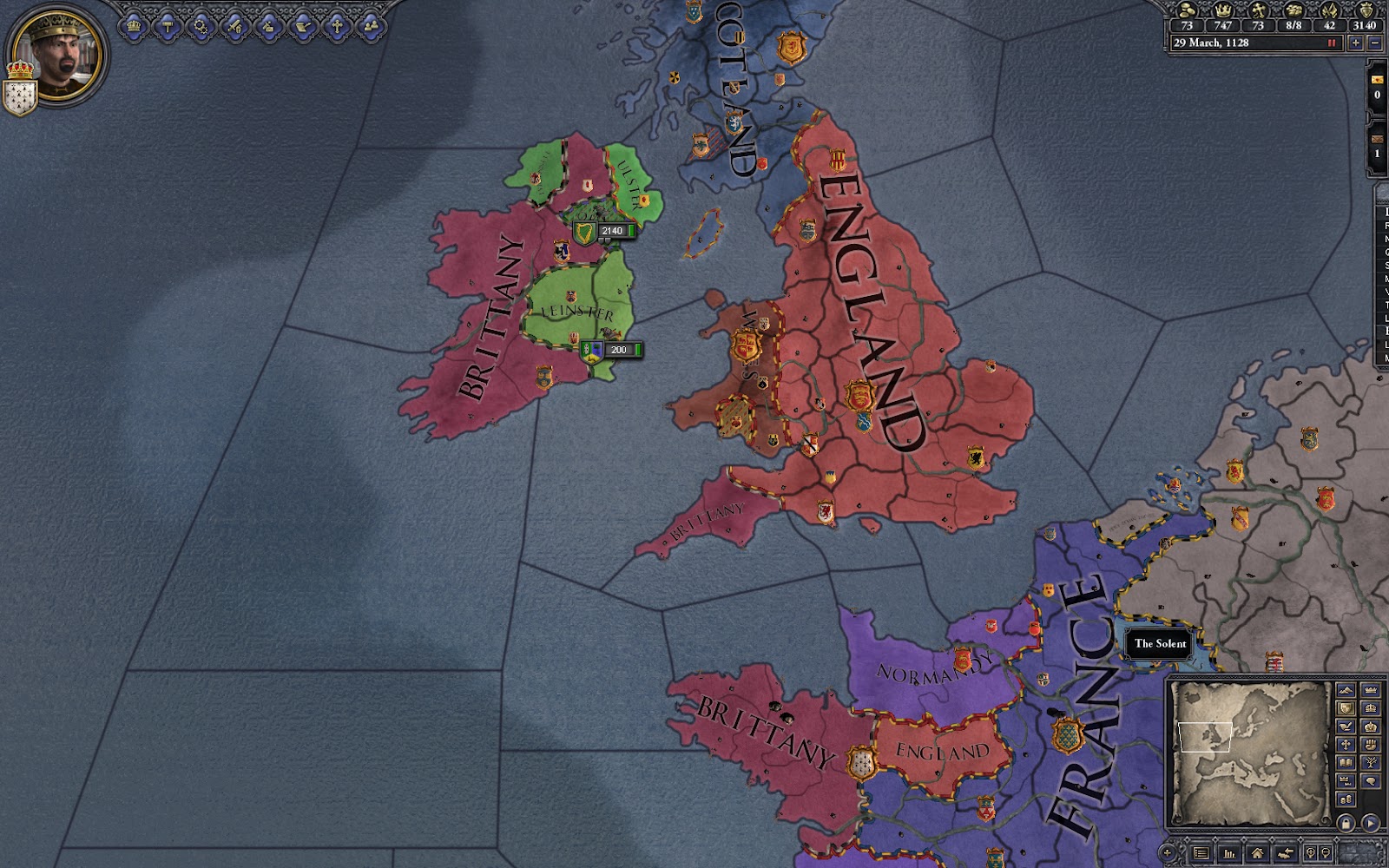

Unfortunately, Barthelemi did not see the fall of Tyr Connell. On the way to that county, he personally led his troops against an Irish peasant rebellion. The king took a savage mace blow to the head, one which shattered his skull and staved in his head. He became a deformed vegetable, alive in name only. His men were forced to drag him to the nearby battles for Tyr Connell, being so far from home, but once his final triumph was achieved, he was left in his chambers in Rennes Castle for the rest of his life.


Judith found herself the real power in Brittany once more. In hopes of currying favor with France, she joined them in putting down a Burgundian rebellion. As an illustration of the strange vagaries of history, Breton troops took part in the capture of the Burgundian Duchess... Heloise, the girl whose betrothal to Barthelemi was broken so long ago.

Barthelemi lingered for eight long years. He died, having never awakened from the battlefield blow to his head, in 1184, at the age of 33, leaving another too young son to take the throne.


It is difficult to properly appraise Barthelemi's career. Of his 29 years on the throne, 13 were before he could legally rule and 8 were after his incapacitating wound; all told, he was only fully in control of the kingdom for 8 years. The other 21 were under the regency of his mother. She was obviously talented and spirited; much of the gains he personally oversaw were set up by her smart rule. But it would be incorrect to give Barthelemi too little credit for the rapid pacification of Ireland which he was responsible for. What his mother began, he finished.

Here's what Europe looks like zoomed out.


Was he a good ruler? That's a far more difficult question to answer. Like so many men and women of power in the Middle Ages, greatness was coupled with terrible, odious qualities. The Irish still hate him, while the people of Brittany look at him with the knowledge that he opened the floodgates of French culture to the insular kingdom. Whatever greatness he achieved is tempered by his feckless flirtations with the French and terrible cruelty to his Irish subjects.

Thursday, June 7, 2012

King Briant I (1149-1155)

It was never proven that Briant killed his father; if he was behind it, no proof exists. Certainly, there were plenty who had cause to see him dead. However it happened, Briant became king in 1149.

He was already middle aged at 40 years of age when he made the trek from Angouleme to Castle Rennes, still under repair from the war against Scotland. He was still, in most ways, the same bookish, shy, humble boy his father and mother had alternately ignored and despised, though he had developed a penchant for angry outbursts of cruelty, no doubt from some internalization of the rude criticisms of his family.

He brought with him his wife, Judith, a fat paranoiac who compounded his misery by demanding constant isolation, lest she and her husband be murdered in their beds. Oftentimes, the new queen would sleep alone, barricaded in her room. The two had still not produced an heir upon their arrival at Rennes.

Briant inherited a bad situation. War in Wales was in full swing, a conflict which was started precisely because his father felt he needed to be replaced. He was honor-bound to see it to its conclusion, no matter the initial cause. As well, revolt was once again threatening to break out across Ireland; rumors of his involvement in his father's death had stirred the lords of Ireland against the crown once again.

The first year of his rule saw Connacht revolt, followed by Tyrone in 1150. Briant let them, as all his troops were running roughshod over the Welsh countryside. Wales was the priority, just as it would have been for his father. It had to be seen through to the bloody end.


Perhaps mercifully, King Llewelyn I of Wales died in battle, leaving his his brother on the throne. This more or less eliminated Elinor's claim to the throne and, with it, any questions about Briant's half-brother's uniting of the two kingdoms. Wales sued for peace quickly after Llewelyn's demise, ceding Devon and Cornwall back to Brittany while not granting Elinor her place on the throne. Briant was happy to take this offer.

The king's military attentions quickly turned to Ireland, that bane of Brittany's peace for three generations. The forces of Tyrone and Connacht had grown fat and complacent in the face of meager Breton resistance. This came to a crashing halt in 1152, as first Tyrone and then Connacht are put down on the field of battle. Special ire was reserved for the forces of Connacht, as Duke Gilla-Patraic was executed during one of those rare but dangerous outbursts on the part of the king.

All settled into normality for a time. Briant and Judith finally had a child, a son, named Barthelemi, in 1151. Born as the Irish rebellions were waning, he was quickly betrothed to the 9 year old Duchess Heloise of Burgundy, in the hopes of folding that storied duchy to the kingdom in due time.

In 1155, Connacht rebelled once again, this time led by the deceased Gilla-Patraic's daughter. Her forces were quickly routed aside by the Bretons, but the army of Brittany was called back to the continent by a large peasant rebellion in Penthievere. The peasants were led by a group of flagellants and, after conducting an impromptu pogrom against the county's Jewish population, let themselves be swept up into conducting a siege of the county seat in their fervor.

Briant landed with his forces and fought the peasant rabble at the Battle of St. Brieuc in the summer of 1155. His horse threw him after it was gored with a spear. The dismounted king was set upon by the peasants, who beat him to death with clubs and rocks. He was 46 years old at the time of his death; his son, the new king, was only 4.


King Conan II "the Wise" (1119-1149)

Let it never be said that the Bretons do not have a sense of humor. While Conan II undoubtedly possessed all of the raw materials to be a smart, capable ruler, his reign saw terrible warfare between Brittany and the other Celtic kingdoms which the de Rennes family so coveted. His epithet, "the Wise", was given early on due to his grasp of military strategy. It was repeated and became a sarcastic signifier sometime after the Scottish captured and occupied Rennes castle.

He was, over his career, ruthless and murderous. He did not shy from violence, unlike his father. Indeed, he reveled in it. It was not cruelty that drove him; one does not see a Vlad Tepes or a Torquemada lurking behind his eyes. It was cold calculation and a will to power which allowed him to sacrifice scores of lives, both Breton and others, in order to achieve his aims. He murdered family members, let his countrymen starve... all in the name of progressing the family fortune.


Conan II was 28 when he came to the throne, married to the Countess-Queen Alix-Adele of Angouleme. There was no love between them; their marriage was a perfect distillation of the medieval arranged marriage land grab. She was a vile woman, deceitful and spiteful. She kicked her servants and  beat her younger siblings. The couple merely tolerated one another, a business arrangement made to secure Angouleme for the de Rennes family. This was made easier by the fact that the Queen largely stayed in Angouleme to oversee her lands once an heir was born.

Their son, Briant, future king of Brittany, was a shy, unassuming boy. He was bookish and introspective; his father called him weak while his mother outright ignored him. When he was the age of majority, he was married off to Eslarmunda de Perigod, a handmaiden in a minor family of Aquitaine. She was rumored to be a lesbian; at the least, only one child, a daughter, was born of their union.

Shortly after being crowned, Conan caught wind of a plot by Count Eudon of Vannes to kill a rival, Gervais de Rohan. In spite of Vannes' long loyalty to the crown, the king opted not to look the other way in this instance and had Eudon arrested. His titles were stripped and given to the crown. This brought, at last, the entire Breton peninsula under the King of Brittany's direct control.

The political situation remained quiet after this for a full three years. In 1123, it erupted and didn't die down for 15 years.

The spark which would ignite a larger conflagration involving Brittany, Scotland, England, Cornwall, and Munster. It began simply enough: a forged document, the same as so many others before it, "proving" a claim on a piece of land. In this case, Conan II made a move on the Duchy of Cornwall. Having his casus belli, he quickly crossed the channel with his army; he made certain to be at the forefront of the action, so as to distinguish himself from his cowardly father.

The small Cornish army was no match for the superior Breton forces. The title of Duke of Cornwall was bestowed upon King Conan II in a ceremony in Tintagel Castle. Not a single Cornishman was present.

Not wasting any time, Conan quickly assembled his armies and invaded Devon, intent on folding the county into his new Cornish holdings. As fate would have it, William III of Normandy had eyes on the rich city of Exeter. He declared war as well, putting the two neighbors at odds over the rule of Devon. Conan and William met on the field of battle, in a great clash of arms at Lydford. William was slain in the battle, trampled by his retreating forces as he tried in vain to rally them.

Conan's forces scarcely had time to breath when the increasingly restive Irish provinces saw a chance to stake their independence. Leading the way was the 18 year old Duchess of Munster, Dubchochaigh. As the year turned to 1124, she led what became known as the Waterford Rebellion, after the site of the first burning of the king in effigy at her urging.

The Duchess was a wily foe. She had the populace, grumbling over high taxes imposed by a foreign lord, with her and she knew the land. Unlike many women of the age, she took a direct hand in the planning and execution of her strategy.

While never proven, evidence exists that she convinced Conan's uncle, Count Gautier of Tyrone, to attempt to overthrow the king. Certainly, it beggars belief that Gautier would start his own rebellion within two months of the Waterford Rebellion's start. Gautier quickly drove south, into Connacht, as Dubchochaigh sent her forces north and west to Galway.

Conan II's shock was reserved mainly for his uncle. He landed his forces in Tyrone, quickly putting a stop to his uncle's rebellion. His uncle pleaded for his life after his capture, invoking God and the bonds of family. Gautier being Conan's favorite uncle, he spared his life and title, releasing him back to his holdings under the oath that he never take swords against his king again.

Munster held out for two years, finally being overwhelmed in 1126. Dubchochaigh, being immensely popular, was allowed to remain as Countess of Desmond, for fear that doing otherwise might spark a general revolt. The ducal seat was transferred to the Mayor of Waterford, Iacob. This vain and ambitious man began styling himself the Doge of Munster, a vanity which Conan largely ignored.

That same year, Gautier of Tyrone was caught plotting another overthrow of the king. He was captured and locked in Rennes' oubliette for the rest of his life. It was perhaps this event which extinguished all pity in Conan II's heart. He loved his uncle and forgave a trespass which most would have not. It is said that the last tears which Conan ever shed in his life fell onto the brow of his beloved uncle as he personally locked the oubliette.

A very brief peace settled over Brittany for the rest of the year and most of 1127. In December of that year, King Saewald I of England declared war on Brittany over control of Cornwall. The English claimant was the sister of the former Duchess of Cornwall. Conan, holding firmer control over his vassals since the Irish rebellions were put down, was able to muster a very large force to counter the English threat. While outnumbered, the Breton forces saw great success against the squabbling English.

It was the English king's soul, however, which would prove to be the site of the longest battle of the war. Conan had been cultivating a friendly relationship with Pope Valentine II, a severe man who was nonetheless susceptible to flattery. Over a period of years, the two men developed a warm relationship. When the English attacked Cornwall, Saewald was excommunicated at the urging of Conan; for dramatic effect, the decree was signed on Christmas Day of 1127. The effect on English morale was devastating, with many of the always headstrong English earls withholding troops and taxes.

With the war against the English going well, albeit with no end in sight, a terrible betrayal which was to define Conan II's reign occurred in December of 1128, almost one year to the day into the war with the English. King Reginald the Lionhearted of Scotland, that same Reginald whose throne was saved by King Riwallon I, declared open war on Brittany.

The catalyst for this conflict was Lady Beatrix of Galloway, Conan's younger sister. She was married to the count of Galloway, one of Reginald's brothers. Reginald's plan was to install her on the throne of Brittany, passing the kingdom to her Dunkeld child and, perhaps, Reginald's own descendants. Extant correspondence between Beatrix and Reginald showed elaborate schemes cooked up to place her on the throne, ranging from slaughter of most of her Breton family to what was finally settled upon: war.

Accounts of the time reveal a king equally enraged and confused. He was left fighting a two front war, stuck in Cornwall, with a massive Scottish force of 7000 soldiers and knights heading for Rennes. Conan ordered all available fighting men raised from the Irish counties; it was not much, perhaps 1500 men, but they quickly made way for the lightly defended Isle of Man.

Conan then made terms with the English when it was obvious that Cornwall was lost; the Breton throne was more important than the tin mines of Cornwall. As part of the peace terms, the Breton forces already in Cornwall were allowed safe passage through England on their way to Scotland; Saewald was only too happy, even in light of the excommunication, to have someone harass the hated Scots.

The Breton troops, with Conan leading the column, began the long march north. The king dispatched a messenger to the continent with the following orders: Eis accipere omnia (Let them take everything).

Hard words, but words which would save the fortunes of the de Rennes family. The Scottish had few defenders at home; almost all of their able forces were in Brittany. This allowed Conan to pick and choose where to siege and where to flee in Scotland proper. In the meantime, the bulk of the Scottish forces slowly dwindled as weather, hunger, starvation, and casualties took their toll.

Conan also authorized the use of mercenary forces from Italy. This was a first for a Breton king; pride and belief in the fighting skill of the Breton people always made such strategies verboten. Several mercenary companies were hired in succession to further whittle down the Scottish invaders. Very few battles by these mercenaries were won, but slowly and surely, 7000 Scots became 6000, 6000 became 5000, until a far less dangerous number were available to commit to siege. Conan's contempt for men who fight for coin rather than king was apparent as he threw the Italians into hopeless battle after hopeless battle, willing to sacrifice their lives at a 3:1 ratio in order to harm the Scots.

The strategy took a terrible toll on the people of Brittany. The castle of Rennes, namesake and ancestral home of the de Rennes dynasty, was lost, partially destroyed in a savage siege. Nantes, Leon, Penthievre... all under Scottish control after battles barely less savage. Crops were burned, women and children slaughtered... a generation of Bretons who had never known the privations faced in war-torn Iberia or Croatia were suddenly faced with terrible hardship.


For all of that, the strategy worked. The Scottish were finally driven into the sea by Conan's mercenary armies and the peninsula liberated. Conan and his forces were never able to make much headway in Scotland, but his throne had been saved. In 1137, with Scotland erupting into rebellion, after nine long years of war, an uneasy truce was declared.


Conan was returning home when word reached him that his eldest daughter, Guigoedon, had died of pneumonia at age 26. His heart hardened further, still; Guigoedon was his favorite child, the apple of his eye.

Early in 1138, Conan concocted a sloppy plan to assassinate his sister, Lady Beatrix, in revenge for her role in the war he'd just concluded. There was no subtlety involved in the plot; Conan quite openly hired a band of thugs to break into her room and stab her to death. They failed, but not before they wounded her grievously. Still, Conan's role in the attack was known throughout Brittany and the Isles, diminishing his stature relative to his peers.

Brittany again settled into stasis. Conan II, the great warrior and strategist, seemed tired of war. He was not, however, tired of bloodshed.

The king saw a problem in his succession. His heir, Briant, was away in Angouleme. Married to a homosexual, with only a daughter as their issue, Conan decided that the easiest way to secure the secession after his passing was to get both Briant's wife and daughter out of the way permanently, so that Briant could remarry a younger, more fertile bride. His spymaster dispatched to France, Eslarmunda de Perigod and Valence, Conan's own granddaughter, were poisoned. This time, the hard-hearted king made certain that his involvement was kept secret. Only documents well after the fact revealed Conan's involvement in the plot.

With Briant free to remarry and succession passing on to a hoped for son, Briant took up with Princess Thora of Norway. It was an extended dalliance of a purely carnal nature, with both trapped in loveless marriages. It was broken off in 1148, when Queen Alix-Adele finally died at the age of 60 after a bout with the flu.

Conan did not mourn her loss. Instead, he entered a marriage with the young sister of the Welsh king, Elinor. She was an attractive, sunny woman, and while there was no more love in his heart, Conan was fond of her. More than that, he saw an opportunity.

Elinor had a claim to the Welsh throne, which was newly declared and uneasily held. If she were to sit on the throne in place of her brother, the throne would pass to her children by Conan. This had the potential to unite the crowns of Wales and Brittany, furthering the dream set down by his grandfather 80 years before.

In 1149, Elinor gave birth to a son named Riwallon, second in line to the throne of Brittany. Conan saw his chance; he raised his armies one more time, sending them to Wales in order to install Elinor on the throne. That this was almost exactly the same casus belli which Reginald the Lionhearted had used in the still stinging betrayal of 20 years prior was not lost on him. When his chancellor brought this irony up, Conan was purported to have replied, "Mal est fait pour moi, de ne pas te."

The war went well. The Welsh were embroiled in a long fought war in eastern Ireland. The Breton forces went nearly unchecked, taking provinces almost unopposed.

There was only one problem: in order to unite Wales and Brittany, Briant had to be out of the way. While Conan held no great love for his son, thinking the prince a weak and sentimental man, he was hesitant to see him dead. After much deliberation, Conan saw no other choice and dispatched his assassins once more to Angouleme. This time, they failed miserably and Conan's role was revealed under torture.

The next day, King Conan II was pushed out of his bedroom window, falling 50 feet to his death. It was never revealed who was behind the accident, if anyone, but Prince Briant of Angouleme became King Briant I of Brittany later that week.